
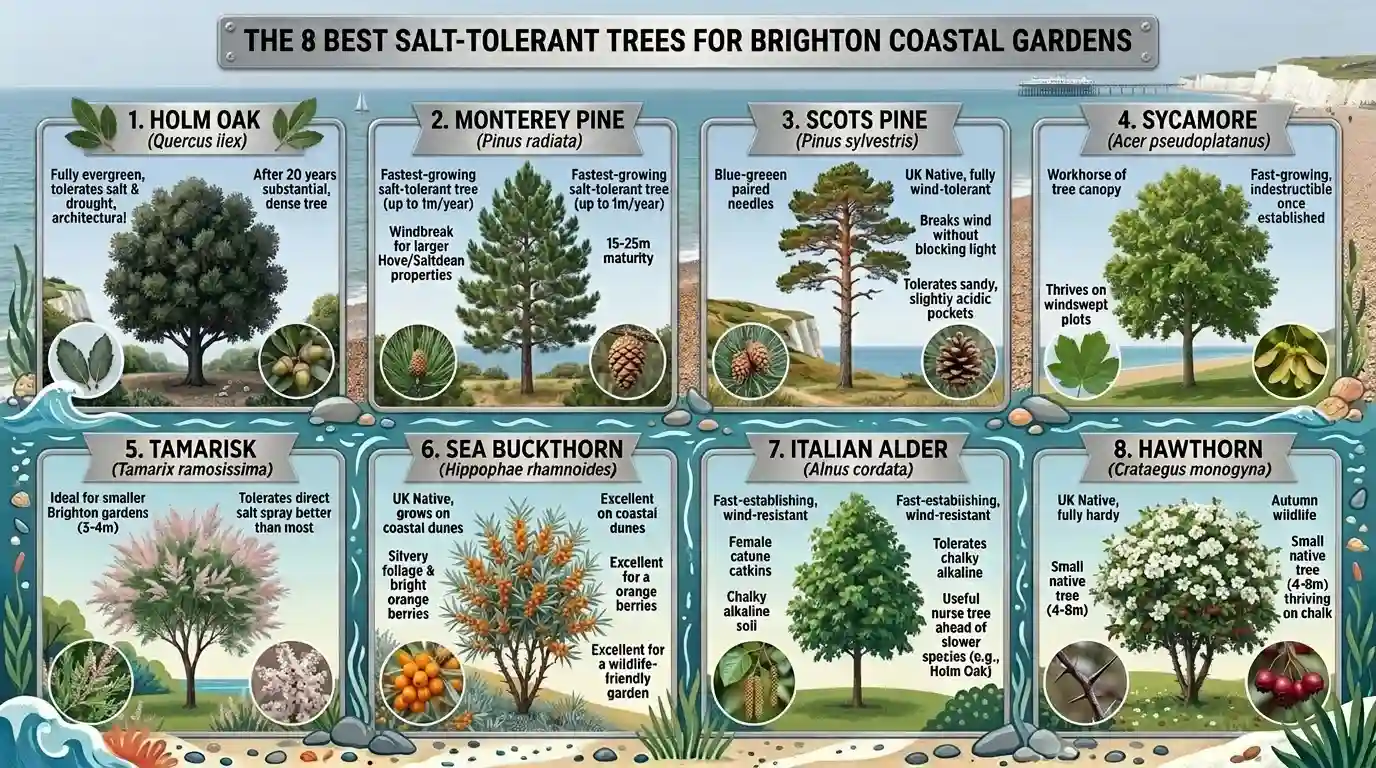
The best salt-tolerant trees for Brighton and Hove coastal gardens are Holm Oak (Quercus ilex), Monterey Pine (Pinus radiata), Scots Pine (Pinus sylvestris), Tamarisk (Tamarix ramosissima), Sycamore (Acer pseudoplatanus), and Sea Buckthorn (Hippophae rhamnoides). These species tolerate salt-laden winds, chalk-based soil, and the exposed conditions that define Brighton’s seafront. Below is a tree surgeon’s practical guide to which species survive, which fail within two years, and what to do if your existing tree is already showing salt damage.
If you need a professional assessment of a coastal tree on your Brighton property, call Brighton Tree Surgeon on 01273 947354 for a free, no-obligation quote.
Why Brighton Is One of the Toughest UK Cities for Trees
Brighton’s tree canopy covers roughly 10% of city land — well below the English average — and the figure drops sharply the closer you get to the seafront. The reason is straightforward: Brighton sits on a thin alkaline topsoil over chalk, and the prevailing south-westerly winds carry salt directly off the English Channel. Salt spray can reach up to 200 metres inland, and coastal wind speeds typically run 30 to 50% higher than at inland sites just a few miles north on the South Downs.
The Victorians and Edwardians who planted Brighton’s streets understood this. They chose elm and sycamore not for beauty, but because those species could actually survive. Today, Brighton & Hove still holds the UK’s National Collection of Elms — the largest surviving population in the country — and that heritage is no accident.
In our 15+ years working across Brighton, Hove, Kemptown, Rottingdean, Saltdean and Peacehaven, we’ve seen homeowners spend hundreds on trees that fail within two winters, simply because they chose species suited to inland Surrey rather than the south coast. This guide is built to prevent that.
What Makes a Tree Salt Tolerant?
A salt-tolerant tree has three biological traits that allow it to survive coastal conditions:
A salt-tolerant tree resists desiccation through waxy, leathery, narrow, or needle-shaped leaves; it can take up water from sandy or chalky soil without being poisoned by salt buildup; and it can withstand mechanical wind stress without losing structural branches. Trees with broad, soft, deeply lobed leaves — like Japanese Maple — fail on the first count alone.
Salt damages trees in two ways. Wind-borne salt spray lands on foliage, evaporates, and leaves crystals that draw water out of leaf cells through osmotic stress. This produces the classic symptom: marginal leaf burn, where leaf edges turn brown and crisp. Salt that reaches the soil prevents roots from absorbing water — a condition known as chemical drought — even when the ground is wet.
The 8 Best Salt-Tolerant Trees for Brighton Coastal Gardens
1. Holm Oak (Quercus ilex)
The Holm Oak is the most architecturally significant coastal tree we work with in Brighton. It is fully evergreen, tolerates salt and drought once established, and grows steadily at 30 to 50cm per year. After 20 years, it forms a substantial, dense, dark-green tree that anchors a garden permanently.
You’ll see mature Holm Oaks across Brighton’s seafront, in Stanmer Park, and along the South Downs fringe. They respond well to clipping and can also be maintained as a 3–4 metre hedge. Best for: medium to large gardens within 200m of the sea.
2. Monterey Pine (Pinus radiata)
The Monterey Pine is the fastest-growing salt-tolerant tree available to UK coastal gardeners — it can establish at up to 1 metre per year once past its vulnerable first two seasons. Native to a narrow strip of the Californian coast, it evolved in conditions almost identical to Brighton: mild wet winters, salt winds, and free-draining soil.
It will reach 15–25 metres at maturity, so it’s not for small gardens, but as a windbreak tree for larger Hove or Saltdean properties it has no equal for speed of establishment.
3. Scots Pine (Pinus sylvestris)
A UK native, fully wind-tolerant, and far more widely available than Monterey Pine. Scots Pine grows tall and relatively open, breaking the wind without blocking light from the rest of the garden. It tolerates the sandy and slightly acidic pockets you sometimes find in Brighton’s coastal gardens, and it’s the easiest pine to source from local Sussex nurseries.
4. Sycamore (Acer pseudoplatanus)
Sycamore is one of the workhorses of Brighton’s tree canopy — historically planted across the city alongside elm precisely because it tolerates salt-laden winds. It is fast-growing, deciduous, and almost indestructible once established. Yes, sycamore self-seeds readily and is sometimes dismissed as weedy. But on a windswept Hove plot where almost nothing else will reach 15 metres, it earns its place.
5. Tamarisk (Tamarix ramosissima)
For smaller Brighton gardens — particularly the typical terraced plots in Hanover, Kemptown, or Hove — Tamarisk is the single most useful coastal tree. It reaches only 3–4 metres, has feathery pink flowers in May and June, and tolerates direct salt spray better than almost any other species. It establishes faster than any other coastal windbreak, often providing meaningful shelter within 18 months of planting.
6. Sea Buckthorn (Hippophae rhamnoides)
A UK native that grows naturally on coastal dunes. Sea Buckthorn produces silvery foliage and bright orange berries, tolerates direct salt spray, and is excellent for a wildlife-friendly garden. It’s smaller than the pines (3–6 metres) and works well as a screening tree on exposed seafront-facing plots in Rottingdean and Peacehaven.
7. Italian Alder (Alnus cordata)
Often overlooked but genuinely excellent for Brighton. Italian Alder is fast-establishing, wind-resistant, and tolerates the chalky alkaline soil that defeats many other species. It’s particularly useful as a fast-growing windbreak ahead of slower species like Holm Oak — plant Italian Alder first, let it establish for 5–7 years, then plant your permanent trees in its shelter.
8. Hawthorn (Crataegus monogyna)
A UK native, fully hardy, and one of the few small native trees that genuinely thrives on Brighton’s chalk. Hawthorn grows to 4–8 metres, produces white spring blossom and red autumn berries, and supports significant wildlife. It’s perfect for smaller front gardens in Brighton’s terraced streets.
Trees to Avoid in Brighton Coastal Gardens
These species fail consistently in Brighton conditions. We get callouts to remove dying examples of all of them every year.
Japanese Maple (Acer palmatum) — Fine, deeply lobed leaves shred in coastal wind and scorch from salt spray. Almost guaranteed to die within two winters on an exposed Brighton plot.
Silver Birch with thin bark — Decorative inland but susceptible to wind rock and salt damage on the coast. The shallow root system is poorly anchored in chalk.
Beech without shelter — Beech needs a sheltered, deep, moist soil. Brighton’s free-draining chalk and salt winds will cause persistent leaf scorch.
Ornamental cherries (most varieties) — Highly susceptible to bacterial canker, which is rampant in Brighton due to humidity and coastal stress. Records show that in 1996 more ornamental cherries were lost in Hove than elms to Dutch elm disease.
Magnolia — Fleshy buds and broad leaves both suffer in salt-laden wind.
Eucalyptus on exposed sites — Some species cope, but most snap or windrock in a Brighton storm.
If you’ve already planted any of these and they’re failing, get in touch — there’s often a recovery path or a sensible replacement plan. Call 01273 947354.
Why Are My Tree’s Leaves Turning Brown? (Salt Damage Diagnosis)
If your Brighton tree’s leaves have turned brown one to two weeks after a coastal storm, you’re almost certainly looking at salt spray damage rather than disease. Here’s how we diagnose it on site:
The damage appears worst on the side of the tree facing the prevailing wind — usually the south or south-west side in Brighton. Browning starts at leaf edges and tips, working inward toward the veins. Evergreen needles turn brown from tip to base. The opposite side of the tree often looks completely healthy. Multiple plant species in the same garden will show the same symptoms simultaneously, which is what distinguishes salt damage from a fungal or pest issue (which usually targets one species at a time).
Most healthy trees recover within one growing season. The exception is repeated, severe exposure or a tree that was already stressed. If you’re unsure, a tree surgeon’s site assessment can usually tell you within 15 minutes whether you’re looking at temporary salt scorch or a genuine decline that needs intervention.
How to Help a Salt-Damaged Tree Recover
If you’ve spotted salt damage on a tree in your Brighton garden, take these steps in order:
1. Rinse the foliage with fresh water. As soon as practical after a storm, hose down the tree’s leaves and lower branches with fresh water. This dissolves salt crystals before they can fully penetrate leaf tissue. For larger trees, this is a job for a tree surgeon with a commercial sprayer.
2. Deep-water the root zone. Slowly soak the soil 6–12 inches deep around the root zone. This flushes accumulated salt below the roots. Do this once a week for 3–4 weeks if rainfall has been low.
3. Avoid fertilising. Most fertilisers are themselves salt formulations and will compound the problem. Hold off until the following spring.
4. Mulch — but correctly. Apply 2–3 inches of organic mulch around the root zone, kept 3–6 inches away from the trunk. This conserves soil moisture and supports root recovery.
5. Wait before pruning. Don’t prune visible damage immediately. Wait until late winter or early spring (just before bud break) to remove confirmed dead wood. Pruning live tissue prematurely adds stress to an already-recovering tree.
6. Call a professional if symptoms persist. If new growth fails to appear in spring, branches die back, or the trunk shows cracks or bark damage, it’s time for a qualified tree surgeon to assess structural safety.
Tree Preservation Orders & Brighton Conservation Areas
Before you fell, prune, or even significantly reshape any mature tree in Brighton & Hove, check whether it’s protected. Many of Brighton’s mature seafront and street trees are covered by a Tree Preservation Order (TPO) or sit within one of the city’s conservation areas — including Kemp Town, Brunswick Town, Montpelier & Clifton Hill, Old Hove, and Regency Square.
Working on a protected tree without council permission is a criminal offence with fines up to £20,000 per tree. Brighton & Hove City Council requires a formal application for work on TPO trees and 6 weeks’ written notice for work on trees in conservation areas (with trunk diameter over 75mm at 1.5m height).
A qualified Brighton tree surgeon will check this for you before any work begins. We do this as standard for every job — you should never accept a quote that doesn’t include a TPO check.
When to Call a Tree Surgeon for a Coastal Tree
Call a Brighton tree surgeon if any of the following apply:
A tree is leaning more than it was after a recent storm. Branches are cracked, split, or hanging. Bark is peeling or weeping sap. New growth has failed to appear after a salt-damage event. Roots are exposed or lifting paving. The tree is dropping leaves out of season. You’re planning to plant a replacement after losing a tree to salt damage. You’re not sure whether a tree has a TPO.
Coastal trees are not garden plants — they are structural assets that, when they fail, fail dangerously. A leaning Holm Oak in a Hove front garden can fall onto a house, a parked car, or a person. Diagnosis from the ground without proper equipment is unreliable.
Get a Free Coastal Tree Assessment from Brighton Tree Surgeon
Brighton Tree Surgeon has been working on Brighton and Hove’s coastal trees since 2009. We are NPTC-qualified, fully insured, and follow BS3998 tree work standards. We cover Brighton, Hove, Kemptown, Rottingdean, Saltdean, Peacehaven, Portslade, Hurstpierpoint, and the wider Sussex coast.
Whether you need to:
- Diagnose salt damage on an existing tree
- Plan a coastal windbreak for a new garden
- Remove a dying tree and choose a salt-tolerant replacement
- Get a TPO check before any work
- Respond to storm damage quickly
We can help. Call 01273 947354 or use our online form for a free, no-obligation quote.
Frequently Asked Questions
What is the best fast-growing salt-tolerant tree for the UK?
Monterey Pine (Pinus radiata) is the fastest-growing salt-tolerant tree available in the UK, establishing at up to 1 metre per year after the first two seasons. For smaller gardens, Tamarisk grows almost as fast and reaches a manageable 3–4 metres rather than 15–25.
Can I plant a Japanese Maple in Brighton?
Only in a fully sheltered courtyard or walled garden well away from the seafront. Japanese Maples have fine, soft leaves that shred in coastal wind and scorch badly from salt spray. On any exposed Brighton plot, they typically die within two winters.
How far inland does salt spray reach in Brighton?
Salt spray from Brighton’s seafront reaches up to 200 metres inland under normal conditions, and significantly further during major storms. Properties south of Western Road in Hove and east of Old Steine are within this primary salt-spray zone. Trees planted in this zone must be salt-tolerant species.
Will my salt-damaged tree die?
Most healthy trees survive a single salt-spray event and produce fresh foliage the following spring. The tree will only die if it was already weakened, if exposure is repeated and severe, or if the species is fundamentally unsuited to coastal conditions. A tree surgeon’s assessment can usually tell you which category your tree falls into.
Do I need permission to plant a tree in a Brighton conservation area?
You don’t need permission to plant a tree in a conservation area. You do need permission to remove or significantly prune one once it reaches 75mm trunk diameter at 1.5m height. If you’re replacing a tree you’ve just removed, contact Brighton & Hove City Council to confirm whether a replacement is required as part of the original consent.
What’s the cheapest salt-tolerant tree for a small Brighton garden?
Hawthorn (Crataegus monogyna) is typically the most affordable option from Sussex nurseries — often £25–£60 for a young whip — and it’s fully native, hardy, and tolerates Brighton’s chalk soil. Tamarisk is similarly affordable and offers more visual interest with its feathery pink flowers.
Should I rinse my tree after every coastal storm?
Not every storm — but yes after major south-westerly gales when you can see or smell salt deposits on cars and windows. A 5–10 minute rinse with fresh water is usually enough. For mature trees over 6 metres, this is realistically a job for a tree surgeon with the right equipment.