
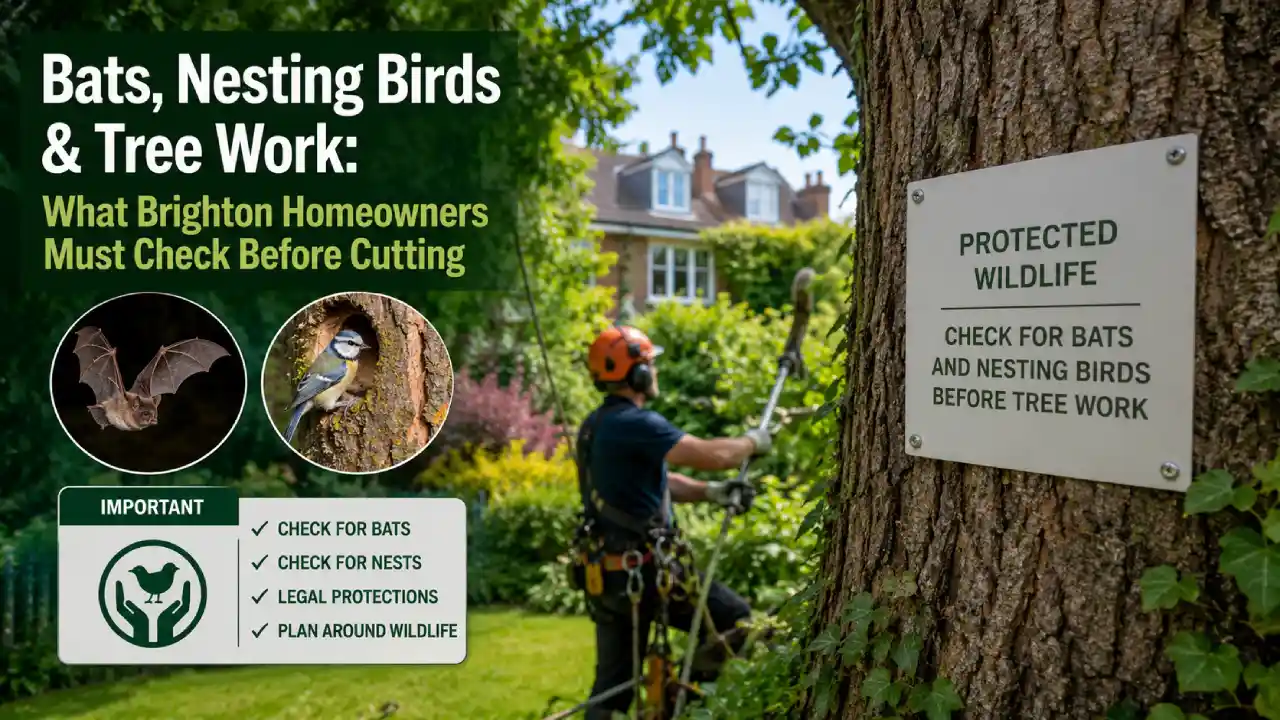
Before you cut, prune, or fell any tree or trim a hedge in Brighton, you must check it for nesting birds and bats. Both are protected by law. All wild birds, their eggs and active nests are protected under the Wildlife and Countryside Act 1981, and it is a criminal offence to intentionally damage or destroy a nest while it is in use or being built. All bat species and their roosts are protected by law too, which can make it a criminal offence to damage or destroy a place a bat uses, even when no bat is present at the time. A quick check before work begins protects local wildlife and protects you from prosecution.
Why wildlife law matters before any tree or hedge work
Most people think of tree work as a practical job about safety and tidiness. In reality it sits inside a clear legal framework. Trees and hedges are some of the most important homes for garden wildlife, and the law treats them that way. The protection does not depend on whether you intended any harm. It depends on whether wildlife was present and whether you took reasonable care to avoid disturbing it.
This matters for every kind of work, from felling a large tree to a light trim of an overgrown hedge. The protection applies to all wild birds, including common species such as pigeons, crows and gulls that some people think of as pests. It is not limited to rare birds. So the first step on any job is not the chainsaw. It is a proper look at what might be living in the tree.
Nesting birds and the law: what you can and cannot do
The rule for birds is straightforward once you know it. Under the Wildlife and Countryside Act 1981, you must not intentionally damage, destroy or take the nest of any wild bird while it is in use or being built, and you must not take or destroy the eggs inside. An active nest is fully protected from the moment a bird starts building it until the young have left.
A small number of birds get even stronger protection. Specially protected birds listed on Schedule 1 of the Act are also protected from disturbance at or near an active nest, which covers the parent birds and their dependent young, not just the nest itself. For homeowners the safest approach is simple. If a nest is active, leave the tree or hedge alone until the birds have finished and moved on.
When is bird nesting season in the UK?
The main bird nesting season runs from March to August inclusive, though some birds nest a little earlier or later depending on the weather. Conservation bodies regularly advise that hedge trimming and similar work should ideally be carried out outside this main season, during autumn and winter, to avoid disturbance.
That advice does not make summer work automatically illegal. It makes it riskier. If work must be done during the nesting season, thorough checks should be made beforehand to confirm there are no nesting birds present at the time. So the honest answer to “can I trim my hedge in summer” is yes, but only after a careful check, and only if you stop the moment you find an active nest. For most jobs that are not urgent, planning the work for autumn or winter is the cleaner and kinder choice.
Bats in trees: stronger protection than many homeowners expect
Bats catch many people out. They are usually linked with lofts and old buildings, but they also roost in trees, and the protection for them is stronger than for birds. In Britain all bat species and their roosts are protected by both domestic and European legislation, mainly under the Conservation of Habitats and Species Regulations 2017 and the Wildlife and Countryside Act 1981.
The key point is this. Because bats return to the same roosts year after year, a roost is protected whether bats are present in it or not. Older trees are often used by bats, and roost sites can include rot holes, woodpecker holes, cracks, and gaps made by splits, loose bark and dying wood. An empty hollow in a mature tree can still be a legally protected roost. That is why a tree that looks like a straightforward removal can turn into a job that needs expert input first.
How to tell if a tree might have bats or nests
You will not always see wildlife directly, so it helps to know what to look for. For birds, watch for adult birds carrying nesting material or food, repeated trips to the same spot, and the sound of young calling from within the canopy or hedge.
For bats, the clues are in the structure of the tree itself. Features such as woodpecker holes, lifting bark, splits, and cavities are signs that a tree may have potential to support roosting bats, especially on older trees and in woodland or along hedgerows. These features are known to ecologists as potential roost features. You cannot always confirm a roost from the ground, which is exactly why an assessment by someone trained to recognise these signs is so valuable before any cutting starts.
What a pre-works wildlife check involves
If a tree shows features that could support bats, the recognised first step is a preliminary ground level roost assessment. This is a ground level search of the tree using binoculars and high powered torches to look for potential roosting features such as cracks, crevices, cavities and holes, along with signs of bats like droppings or staining.
The timing of this check is flexible, which is helpful for planning. A ground level assessment can be carried out at any time of year, and it is often easier to spot features in winter when there is less foliage. The result decides what happens next. Trees found to have negligible or low potential usually need no further survey, while trees with moderate or high potential may need additional inspection. Where a closer survey is needed to confirm whether bats are using a feature, dusk emergence and dawn return surveys can only take place between May and September. If a roost is confirmed and the work still needs to go ahead, a licence from Natural England is required, and that process takes planning and time.
The penalties for getting it wrong
This is where the consequences become real. Each offence relating to bats can carry a fine and up to six months in prison, and each individual animal affected can be treated as a separate offence. Breaking bat protection law can lead to an unlimited fine, up to six months in prison, and forfeiting the equipment used.
There is one point that surprises many homeowners. A felling licence does not remove your responsibility to protect species such as bats, and the law still applies during the breeding and nesting seasons. There is a limited defence if the harm was the incidental result of a lawful operation that could not reasonably have been avoided, but you would need to show you had followed best practice. In plain terms, having permission to fell a tree is not the same as having permission to harm the wildlife living in it.
Brighton’s conservation areas and tree preservation orders
Brighton and Hove has many characterful streets and historic neighbourhoods, and a number of these are designated conservation areas with extra protection for their trees. On top of wildlife law, individual trees may be covered by a tree preservation order, and trees in conservation areas have their own rules that usually require you to notify the council before work.
This means a single tree can be protected in more than one way at once. It might sit in a conservation area, carry a preservation order, and also be home to nesting birds or a bat roost. Each of these needs to be checked and respected separately. Before any work in Brighton, it is worth confirming the tree’s status with Brighton & Hove City Council as well as carrying out the wildlife checks described above.
What to do if you find a nest or bat during work
Sometimes wildlife is only discovered once work has begun. If that happens, the right response is to stop straight away. The recommended action is to cease work immediately, move away carefully to reduce further disturbance, and seek advice from an appropriate body before doing anything else.
For an active bird’s nest, leave it undisturbed and wait until the young have fledged and the nest is no longer in use before continuing. For bats, do not attempt to handle them or clear the feature, and take advice from an ecologist or the Bat Conservation Trust. Carrying on regardless is the single most common way that a routine garden job turns into a criminal offence.
How a professional tree surgeon keeps you on the right side of the law
A good tree surgeon does far more than cut. Part of the job is recognising the signs of protected wildlife and knowing when a tree needs an assessment before work can safely and lawfully go ahead. This is exactly the knowledge that protects you as the homeowner.
At Brighton Tree Surgeon we factor wildlife and the local rules into how we plan every job. That means checking trees and hedges before we start, advising on the best season for the work, flagging when a tree shows features that may need a specialist assessment, and helping you understand any conservation area or preservation order obligations with the council. The result is work that keeps your garden safe and tidy, protects Brighton’s wildlife, and keeps you clear of any legal risk. If you are planning tree or hedge work this year, the safest first step is a quick conversation before anything is cut.
Frequently asked questions
Is it illegal to cut a tree with a bird’s nest in it?
Yes, if the nest is active. It is a criminal offence to intentionally damage or destroy the nest of any wild bird while it is in use or being built. You should wait until the young have fledged and the nest is no longer in use.
When is bird nesting season in the UK?
The main season runs from March to August inclusive, although it can start earlier or end later depending on the weather and species. Work such as hedge trimming is best done in autumn and winter to avoid disturbance.
Are bats protected when you fell a tree?
Yes. All bat species and their roosts are protected by law, and it can be an offence to damage or destroy a roost even when no bat is present.
Do I need a survey before cutting down a tree?
Sometimes. If the tree has features that could support bats, a preliminary ground level roost assessment is the recognised first step, and a qualified ecologist will advise whether further survey work is needed.
What happens if I disturb a bat roost?
The penalties are serious. They can include an unlimited fine, up to six months in prison, and forfeiting the equipment used.
Does a felling licence mean I can ignore wildlife law?
No. A felling licence does not remove your responsibility to protect species such as bats and nesting birds.
What should I do if I find a nest or bat during work?
Stop immediately, move away carefully, and seek advice before continuing. Do not handle bats or clear an active nest.